


ITMIG Newsletter
Volume 14
Autumn 2026
Steering Committee
Dirk Van Raemdonck
The Steering Committee meets regularly to discuss society matters, including committee and working group activities, annual meeting planning, and ongoing projects. Twice a year, all members are invited to join Steering Committee calls. Details are shared with the membership once the dates are confirmed.
The 2025-2026 term of office will end in October this year. Dr. Dirk Van Raemdonck will step down as President, and Dr. Stéphanie Peeters will join the board as Treasurer.
The new board will consist of:
- President: Dr. Paolo Mendogni
- Vice-President: Dr. Annemarie Fernandes Shepherd
- Secretary: Dr. Chul Kim
- Treasurer: Dr. Stéphanie Peeters
- Past President: Dr. Dirk van Raemdonck
Ms. Pam Bruce (pbruce@thymic.org) continues to serve as ITMIG Executive Director and is happy to assist with board contacts and any other matters concerning the Society.
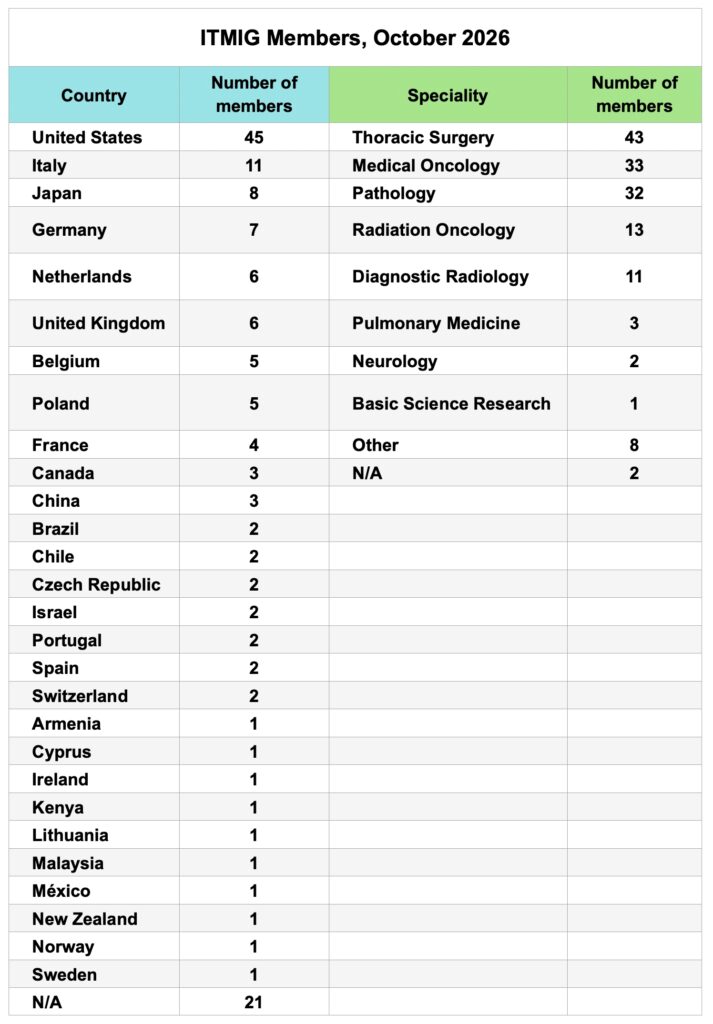
As of October 13, 2026, ITMIG had 149 active members from around the world, representing various specialties. Join our team and become an ITMIG member!
Education Committee
Wentao Fang
The ITMIG Education Committee aims to disseminate knowledge and advances in management and research on thymic malignancies to the global community through various platforms. These include our official journal Mediastinum, which is indexed by PubMed and Scopus. ITMIG members are welcome to join the editorial board and contribute review or research papers to the journal. On the ITMIG website, there is a ‘Pivotal Publication’ column, introducing the ITMIG definitions and policies, as well as important recent publications on mediastinal diseases. There is also an Education and Research panel on our website, providing educational materials, online courses, and useful clinical tools for our members. ITMIG members are encouraged to recommend pivotal publications and contribute educational material to our website through the Education Committee.
Since 2025, the Education Committee has been working on the ITMIG clinical guidance on management of thymic tumors. These ongoing projects aim to tackle a series of clinical questions in daily patient care. Because of the rarity of the disease and the limitations in existing literature, a novel approach has been proposed by Frank Detterbeck that is different from the traditional guideline process. Experts from different specialties are gathered to discuss clinically oriented patient-important (COPI) questions on various clinical scenarios, examine potential confounders in the literature that impact outcomes, summarize evidence regarding clinical relevance and uncertainty, and create useful tools for individualized decision-making for frontline clinicians.
The first project, postoperative radiation therapy (PORT), led by Benjamin Resio, is almost complete and is now in the process of building the clinical tool based on evidence gathered. With the experience collected during the process, a second project on minimally invasive surgery (MIS) has just started, led by Luigi Ventura. Hopefully, it can be completed by the end of next year so that we can move on to the third one on neoadjuvant therapies. Any ITMIG member who is interested and is willing to contribute is welcome to join forces.
The PORT Project: A Deep Dive into Nuances and Interplay of Aspects of PORT to Enhance Decision-Making
Frank Detterbeck, Benjamin Resio
Whether addition of PORT (post-operative radiotherapy) after resection of a thymic malignancy is useful is a frequent clinical question. Existing guidelines provide conflicting recommendations, reflecting that studies have reported conflicting results. The education committee assembled a multidisciplinary group to address this issue, led by Ben Resio from Yale University.
The PORT working group developed an approach to evidence review that is the model for ITMIG clinical guidance projects in general. This entails a deep dive into details and confounders; by ordering studies according to multiple such details and assessing across studies, patterns of associations emerge that are obscured by the traditional approach of lumping everything together and assessing an average. The deep dive approach sees the differences among studies as an opportunity to uncover patterns; critical assessment of multiple perspectives provides an ability to assess whether an outcome can be reasonably attributed to a particular factor. The novel approach also entails recognition of degrees of confidence and of uncertainty related to the insights gained. This approach has provided an order of magnitude deeper grasp of the state of knowledge regarding PORT. Thus, the approach maximizes the insight gained, by delving into the nuances and interplay of multiple study characteristics (or was it the nuances and interplay of the grapes and the wood of the barrel?).
The second phase of the PORT project is to translate the insights gained into a practical system that enhances point-of-care decision-making for patients. This also involves a novel approach consistent with the general model of the education committee for decision-aids. The decision-aid is focused on the process of care delivery and how decisions are made for each individual patient. It provides a rapid summary and highlights the considerations that will be the most important drivers of a decision. Further details of how to individualize the considerations for a particular patient involve visualization of the available knowledge and how various characteristics affect the interplay between various relevant outcomes. This is markedly different than the traditional guideline approach, which presents a general recommendation for an average population relative to one outcome.
User-testing of a prototype of the PORT decision-aid is underway and will be available to try out at the ITMIG 2026 meeting. An app for the PORT decision-aid is under development through ITMIG’s partnership with the AME publishing company (the publisher of Mediastinum, the official ITMIG journal). Completion of the PORT project (anticipated by the end of the calendar year) marks a major new step for ITMIG in improving outcomes for people with thymic malignancies.
Database Committee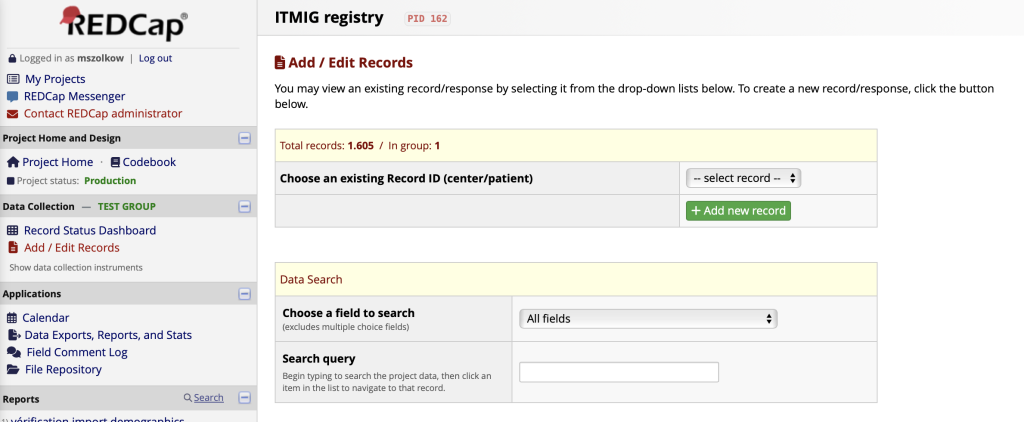
Nicolas Girard
Thanks to your continued commitment, the ITMIG Prospective Database continues to grow and strengthen its role as a unique international resource for thymic malignancy research.
We are pleased to report that the database now includes more than 1,900 patients, with new contributing institutions joining regularly. This collective effort reflects the dedication of the ITMIG community and reinforces our ability to answer important clinical and scientific questions in the field of thymic tumors.
We would like to thank all participating centers for their invaluable contributions. Every patient entered into the database increases the quality, robustness, and impact of future research projects.
We are also excited to announce that two research projects using the ITMIG Prospective Database are currently underway. These studies highlight the growing scientific value of the database and demonstrate how collaborative data sharing can generate meaningful advances for patients with thymic malignancies.
In addition, ITMIG is actively collaborating with the IASLC to support the development of the 10th edition of the TNM Classification. The prospective database is now positioned to contribute to this important international effort, ensuring that thymic tumor staging continues to be informed by high-quality, contemporary data from centers around the world.
As these initiatives move forward, we encourage all members to remain actively involved. If your institution has not yet joined the database, or if you need assistance with site activation, data entry, or updating your Data Transfer Agreement (DTA), our team remains available to help.
For current contributors, we strongly encourage continued patient enrollment and regular data updates. Your participation is essential to maximizing the scientific value of this resource and to maintaining ITMIG’s leadership in collaborative thymic tumor research.
Thank you again for your support, commitment, and contributions. Together, we are building a stronger foundation for future discoveries and improving outcomes for patients worldwide.
Communication Committee
Chul Kim
The Communication Committee continues to promote ITMIG activities among members and the broader public. Our work includes supporting Thymic Malignancy Awareness Month (TMAM) and annual conferences, maintaining the ITMIG website and YouTube channel, sharing updates through social media, and preparing the annual newsletter.
For TMAM 2026, the May–June webinar program covered a broad range of topics relevant to healthcare professionals, patients, and families:
- May 20: Updates in Clinical Guidelines for Thymic Epithelial Tumors.
- May 20: Practical Challenges in the Treatment of Thymic Tumors, a Portuguese–English webinar covering surgery, radiation therapy, and multidisciplinary care.
- May 22: Clinical Trials and Emerging Therapies in Thymic Epithelial Tumors.
- May 28: Challenges in Thymic Tumor Pathology.
- June 9: Availability of Treatment Methods and Specialized Diagnostics for Thymic Epithelial Tumors in Different Countries.
Selected recordings from the 2026 program are available on the TMAM webpage. Recordings from previous years can also be accessed through the ITMIG webinars page.
We thank all speakers, moderators, collaborating organizations, and participants for contributing to these educational activities. We welcome suggestions for future webinars and colleagues interested in supporting our communication efforts.
To join the committee or share ideas, please contact Chul Kim (Chul.Kim@gunet.georgetown.edu) or Pam Bruce (pbruce@thymic.org).
Ambassadors Committee
Dirk Van Raemdonck
The Ambassadors Committee is a new committee dedicated to promoting the ITMIG society worldwide through individuals in each country volunteering to recruit new potential members and to distribute information on ITMIG activities at national conferences and local meetings. The committee will first meet at the 2026 annual meeting in Sao Paulo. Please contact Pam Bruce (pbruce@thymic.org) in case you are interested to represent your country.
Biology Working Group 
Thierry Molina
The ITMIG Biology Working Group was launched in December 2023, aiming to bring together MDs and/or PhDs interested in a better understanding of the biopathology of these tumors and to facilitate the evaluation and/or validation of projects at an international level through ITMIG. This group works on sample collections (blood, serum, tumor) linked to the ITMIG database and their availability through a collaborative project. Since 2025, Zoom calls have been held once a month on a Monday.
Since the 2025 Milan Meeting, Chris Nabel, Rohan Maniar, Anja Roden, Malgorzata Szolkowska, Maria Isabel da Silva Leite, Jan von der Thusen, Fatemeh Ardeshir, Patrick Loehrer, Mirella Marino, and Thierry Molina have been participating.
The first project discussed by the group, which is still ongoing, is TARGETTHYM-1, proposed by Dr. Nicolas Girard. There was a consensus among the participants to approve this project as the initial project for the Biology WG. TARGETTHYM-1 is the first sub-project based on the ITMIG prospective database infrastructure. Led by the Biology Working Group, the study aims to collect data from patients with thymic malignancies who received targeted therapies—excluding antiangiogenic agents and immunotherapy—for advanced disease. We will collect data on molecular alterations, if any, identified through genomic profiling and correlate the clinical course with the type of targeted therapy, TET subtype, and potential molecular alterations. The project is open: to participate, please contact nicolas.girard2@curie.fr or his database manager, paulette.salamounfeghali@curie.fr, to include patients in this project using a specific CRF in the ITMIG database. Regulatory rules that vary across countries have slowed down the project. However, new patients have recently been included from Poland and the US.
During 2026, while working on TARGETTHYM-1, the working group decided that it would also serve as a place for members to present projects or results and discuss published papers on the biopathology of TETs to better develop an ITMIG biopathology project.
- Maniar and Loehrer presented the Indiana database infrastructure, which dates back to 2000, with a REDCap-based clinicopathological database and a BC2 team (Biospecimen Collection and Banking Core) building a data platform combining clinical data, cancer registry data, biospecimen data, and genomic sequencing data. The goal is to improve the flow of research by breaking down barriers between teams and departments. This team schedules blood plasma sample collection on the day of surgery as well as at prespecified milestones.
- Chris Nabel informed us about his work on apoptotic resistance using cell lines and xenografts to focus on targetable alterations.
- We discussed the paper by Tagliamento (NPJ Precision Oncology, 2024) on molecular features of thymoma and thymic carcinoma in tumor tissue and blood. The WG emphasized the importance of whole blood in addition to PBMCs and plasma to optimize molecular analysis.
- We discussed the paper by Dr. Fatemeh Ardeshir (JCO Precis Oncol 7, e2200465, 2023), comparing the molecular landscapes of primary and metastatic TETs in tumor tissue and blood. TP53 mutations were found in 31% of metastatic thymomas and 36% of carcinomas. Three main oncogenic pathways were identified (TP53/CDK, EGFR/RAS, PI3K/MTOR). Few germline mutations were found among these patients. P53 mutations seem to be an interesting, potentially prognostic marker in thymic carcinomas.
- We have been discussing two papers on spatial transcriptomics in pancreatic carcinoma (Guo JA et al., Clin Cancer Res. 2021; Khaliq AM et al., Nat Genet. 2024) and one paper on myasthenia-associated thymoma (Yasumizu et al, Cell Rep. 2024) to evaluate the value and limitations of this approach in published papers. The WG emphasized the importance of defining the research question before performing the experiment; the crucial role of the pathologist, who should be involved at the beginning of the project and in the selection of controls; the huge amount of data generated; and the difficulty of unsupervised analysis.
- In the near future, Dr. Rohan Maniar will present his experience with spatial transcriptomics in TETs, as well as the link with Kairos to evaluate the percentage of germline mutations in TETs compared with that reported in the German paper.
If you are interested in this working group, please contact Dr. Thierry Molina (Thierry.molina@aphp.fr). If you have ideas for new projects, please join us and work with us.
AI Working group 
Jan von der Thüsen
The ITMIG AI working group aims to provide advice and a meeting place for those interested in setting up or supporting AI projects in mediastinal diseases. Over the past year, its members have been finalizing a survey on attitudes towards, experience of, and requirements for the use of artificial intelligence in thymic epithelial tumors (TETs). This survey has been distributed across the membership of ITMIG (many thanks to Malgorzata Szolkowska and Pam Bruce for their help with this), and it is now closed. Many thanks to all of you who have dedicated your valuable time to answering the survey questions! The data are currently being analyzed, and we are eager to share the first results with you at ITMIG 2026 in São Paulo.
As TETs are rare, and AI models are data-hungry and require external validation, collaboration between centers to increase the number of cases, especially of ultra-rare variants of TETs to address class imbalance, is imperative. ITMIG offers a unique platform to facilitate this type of collaboration, and we have been carefully exploring possibilities for data transfer according to international regulatory practices. This work is currently still ongoing, but once it is complete, the first model to be developed will try to predict intra-class recurrence patterns of early-stage TETs. The working group has a virtual meeting on the first Friday of every month and welcomes new members, especially clinicians and radiologists! If you have any questions or would like to enquire about joining the WG, please contact its current chair, Jan von der Thüsen (j.vonderthusen@erasmusmc.nl).
 Tumor Board
Annemarie Shepherd
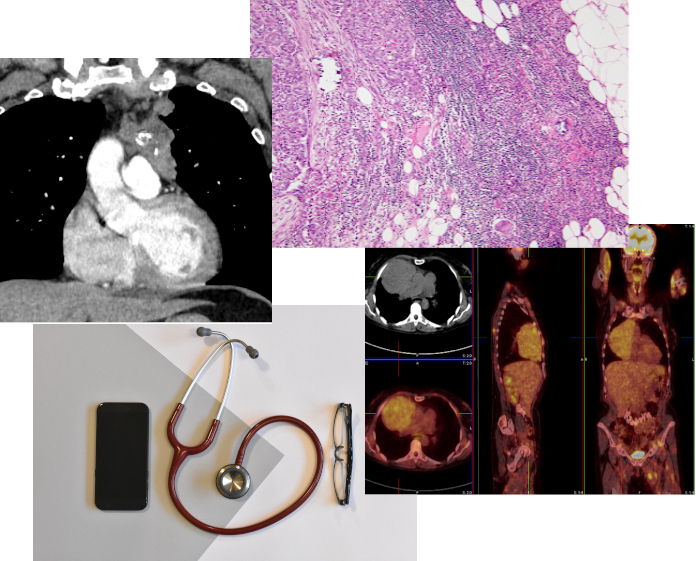
The ITMIG Virtual Tumor Board continues to provide a unique forum for multidisciplinary discussion of challenging thymic malignancy cases from around the world. In 2026, the Tumor Board has met five times to date, reviewing six cases involving patients from three different countries. The cases have prompted lively discussions spanning the spectrum of thymic malignancies and have highlighted the value of collaboration among experts in thoracic surgery, medical oncology, radiation oncology, radiology, and pathology.
Two of the cases presented this year were follow-up discussions of patients previously reviewed by the Tumor Board, allowing the group to revisit clinical decision-making as these patients’ diseases evolved. One particularly notable case involved a 12-year-old boy with multiple recurrences of lymphoepithelial thymic carcinoma. Other cases generated discussion regarding the management of pleural metastases, the role of postoperative radiation therapy (PORT), and treatment strategies for locally invasive disease.
The Tumor Board has also provided an opportunity to share these challenging cases more broadly. Two cases discussed through the Tumor Board were recently published as case reports in Mediastinum, including a very late recurrence of thymoma and a rare giant large cell neuroendocrine carcinoma [1,2].
We welcome cases from ITMIG members and colleagues worldwide. If you have a challenging case that would benefit from multidisciplinary discussion, please submit it through the ITMIG Virtual Tumor Board case submission portal. ITMIG members interested in attending Tumor Board meetings are also encouraged to contact Pam Bruce at pbruce@thymic.org.
[1] Cangir AK, Sak SD, Güneş G, Çoruh AG, Dursun Ş, Akyürek S, Köksoy EB, Van Raemdonck D, Strange C, Arrossi A, Roden AC, Rajan A, Komaki R, Shepherd A. Very late recurrence of thymoma after 14 years: an International Thymic Malignancy Interest Group Tumor Board case report from a Turkish multidisciplinary team. Mediastinum. 2026 Aug 26;10:41. doi: 10.21037/med-2026-0017. PMID: 42763666; PMCID: PMC13589316.
[2] Cangir AK, Sak SD, Güneş G, Çoruh AG, Dursun Ş, Akyürek S, Köksoy EB, Van Raemdonck D, Strange C, Arrossi A, Roden AC, Rajan A, Komaki R, Shepherd A. A rare giant large cell neuroendocrine carcinoma: an ITMIG Tumor Board case report from a Turkish multidisciplinary team. Mediastinum. 2026 Aug 27;10:42. doi: 10.21037/med-2026-0018. PMID: 42763668; PMCID: PMC13589319.
SAVE-THE-DATE
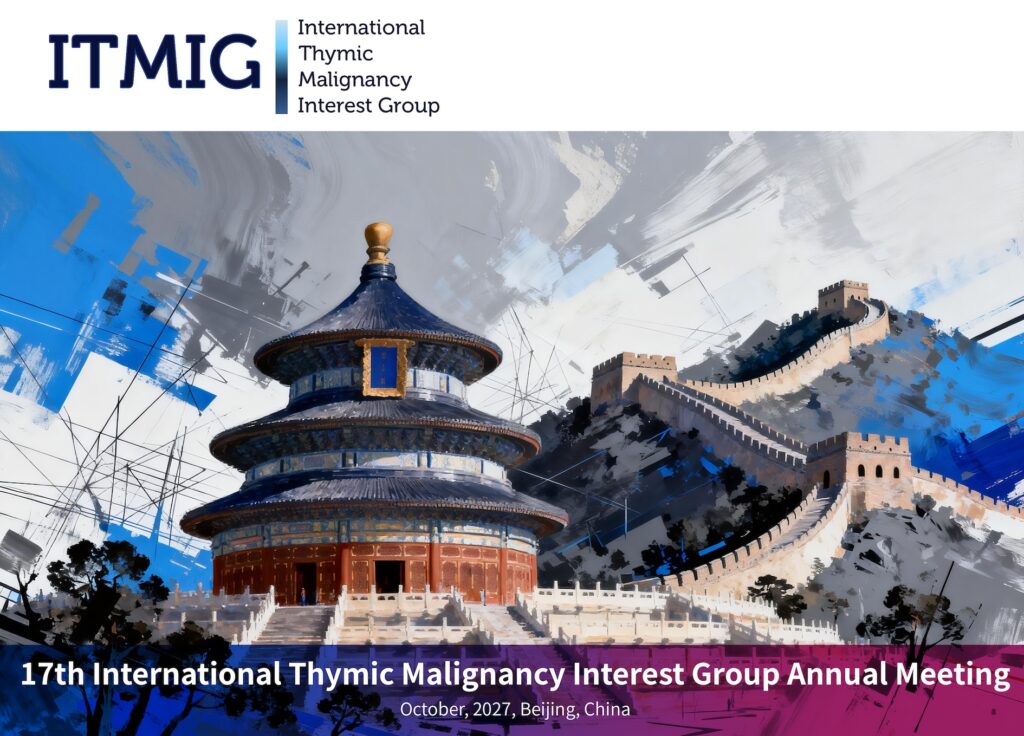
ITMIG2027 Annual Meeting
with Systemic Therapy Workshop for non-Medical Oncologists
14-16 October 2027, Beijing, China
MEDIASTINUM – An Official ITMIG Journal
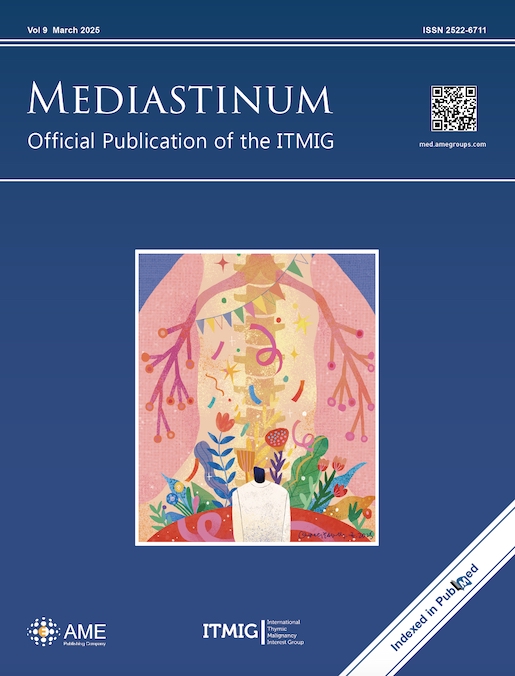
As of May 2024, MEDIASTINUM (https://med.amegroups.org/) serves as the official journal of ITMIG. MEDIASTINUM is an open access journal for high-quality research in mediastinum. ITMIG members who submit a manuscript through the ITMIG website are eligible to a 30% discount on article processing charge. For more information, visit the ITMIG homepage.
All abstracts from ITMIG2026 will be published in the Abstract Book on the MEDIASTINUM website and will be available in the PubMed Central database.
ITMIG Communication Committee